Memory Hierarchy
The pccx v002 memory subsystem is a four-level hierarchy: host DDR4 → Weight Buffer / L2 Cache → L1 / Constant Cache → registers inside each PE. Each level is sized to match the bandwidth of the next and to prevent data starvation in the compute cores.
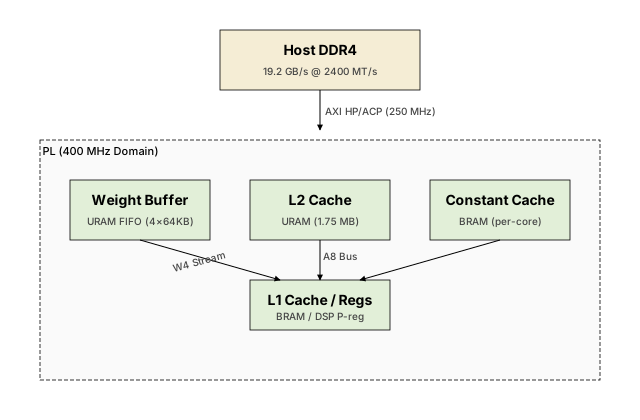
Figure 6 pccx v002 Memory Hierarchy & Interconnect Architecture. Weights and activations are staged from host DDR4 through URAM-based L2 and Weight Buffers to the compute-local BRAM caches.
1. Hierarchy
Level |
Media |
Capacity (KV260) |
Peak Bandwidth |
Purpose |
|---|---|---|---|---|
L0 Register |
FF |
Inside DSP48E2 |
48 bit / clk / DSP |
Accumulator |
L1 Cache |
BRAM |
A few KB per core |
32 element / clk |
GEMV activation / result staging |
Constant Cache |
BRAM |
A few KB per core |
16 bit × N / clk |
ISA shape/size pointers, scale factors |
L2 Cache |
URAM |
1.75 MB (114,688 × 128-bit; ~50 of 64 URAM) |
256 bit × 2 / clk (both slices) |
Activations, KV cache, intermediate results |
Weight Buffer |
URAM (FIFO) |
4 × 64 KB (4 HP ports, 4096 deep each) |
128 bit/clk per HP port @ 250 MHz |
INT4 weight stream |
Host DDR4 |
External DRAM |
4 × 512 Mb × 16-bit |
19.2 GB/s |
Model weights, inputs, token outputs |
2. Bandwidth Matching
2.1 Weight Path
Goal: the HP ports must deliver enough weight bandwidth to feed the GEMM systolic array each cycle.
Systolic array: 32 × 32 = 1,024 DSP at 400 MHz (one grid, cascade split at row 16 into two 32 × 16 sub-chains).
With W4A8 dual-channel packing, 1 DSP = 2 MAC, so 2,048 MAC/clk.
Weight demand: 2,048 × 4 bit = 8,192 bit/clk @ 400 MHz.
Supply: HP0 + HP1 deliver 2 × 128 bit/clk @ 250 MHz (64 Gbit/s total raw), which normalizes to ~160 bit/clk @ 400 MHz downstream of the CDC FIFO.
The gap is closed by weight reuse (Weight Stationary): the GEMM systolic array preloads weights once and reuses them for hundreds to thousands of cycles; the Weight Buffer only prefetches. See GEMM Core (Systolic Array) for the exact reuse pattern.
2.2 Activation Path
Goal: L2 cache must satisfy concurrent activation reads from GEMM, GEMV, and SFU.
L2 cache ports: dual-port URAM — ACP DMA on Port A, NPU compute on Port B, both 128-bit wide per cycle.
Peak per-slice activation demand from the GEMV cores: 4 cores × 32 INT8 elements per clock = 128 INT8 elements per clock total. A single 128-bit URAM read supplies 16 INT8 elements per cycle, so the GEMV broadcast path (the same activation is reused across all four cores) fits within a single port.
2.3 Host ↔ Device Path
Goal: load model weights during prefill, and support KV cache updates plus token output during decoding.
DMA via AXI ACP port. Capped by host DDR4’s 19.2 GB/s.
At the v002.1 throughput target (~20 tokens/s; see Roadmap) the host ↔ device traffic is dominated by KV cache updates and new token writes — well within the budget.
3. Cache Operating Policy
3.2 Constant Cache: ISA Pointer Backing Store
The ISA references shape / size metadata through 6-bit
shape_ptr_addr and size_ptr_addr fields. These pointers index
into the Constant Cache’s 64 entries, which are preloaded by MEMSET. See
Per-Instruction Encoding for the encoding.
3.3 Weight Buffer: Streaming FIFO
The Weight Buffer is implemented as a circular FIFO that absorbs the timing difference between HP port prefetch and core consumption. It supports both GEMM’s Weight Stationary reuse and GEMV’s Weight Streaming pattern via bank-level interleaving.
4. Preventing Data Starvation
Pipeline stalls are avoided with double-buffering throughout:
GEMM activations: ping-pong buffers between L2 and the PEs.
GEMV activations: L1 cache partitioned across banks so that reads and writes proceed in parallel.
Weights: ping-pong FIFO inside the Weight Buffer.
The design targets 100% utilization on every compute core under ideal conditions. Measured utilization will be reported in the Implementation section once synthesis results are in.